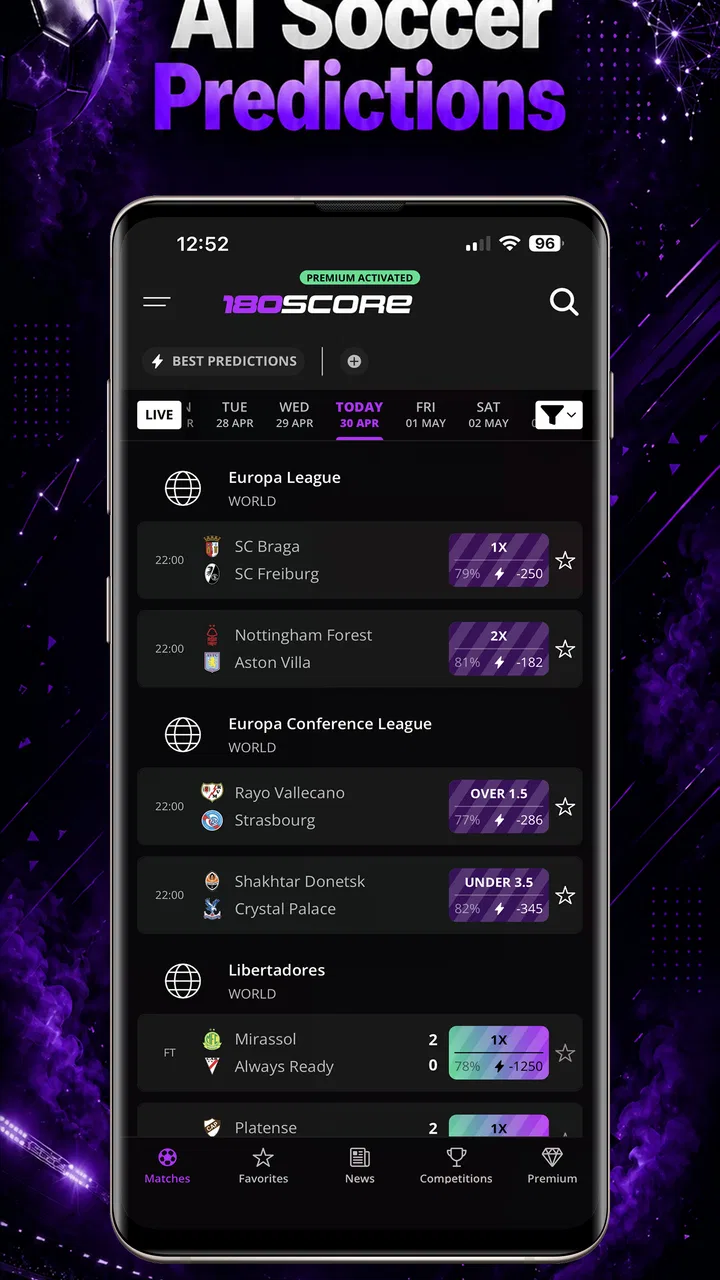
180Score AI Soccer Predictions
- 4.2
- Rating
- 1.00M
- Installs
- Free
- Price

 Analysis by App-foxy
I found 180Score AI Soccer Predictions most useful when I treated it as a quick decision-making companion rather than a replacement for watching matches or doing my own research. It brings predictions, live scores, statistics, and match alerts into one sports app, with artificial intelligence used to turn match information into readable forecasts. That combination makes it appealing for followers who want a faster way to scan a busy football schedule, especially when several games are taking place at once.
My overall view is positive but measured. The app can save time and give structure to pre-match thinking, yet a prediction is still an estimate, not a promise. I would recommend it to football fans who enjoy comparing possibilities, tracking fixtures, or building a personal match routine. I would be more cautious about recommending it to anyone looking for certainty, deep tactical analysis, or a completely free experience with no premium pressure.
How 180Score fits into a football fan’s routine
The first thing I noticed is that the app is designed around speed. Instead of moving between a scores service, a statistics page, and a separate alert tool, I can use one place to check what is happening and what the prediction engine expects. That matters on a weekend when the fixture list becomes crowded and I do not want to research every match from scratch.
You May Also Like

 Blood Strike: 2.5 Anniversary
Blood Strike’s Loadouts Turn Every Drop Into a Tactical Gamble
A close look at Blood Strike’s custom loadouts: how fast access to signature weapons reshapes its battle royale rhythm, rewards preparation, and narrows the gap between fights.

 Pandora - Music & Podcasts
Pandora’s Music Is Easy to Start, but Harder to Recover
Pandora’s strength is its low-effort path from a seed to a station. Its weak spot is how much confidence it asks you to place in connection, setup, and quiet recovery.

 8 Ball Pool
 Is Built on Rivalries, Rematches, and Routine
A close look at the rivalries, rematches, shared routines, and unanswered safety questions that turn a quick pool match into a persistent mobile community.

 Samsung Music
’s Quiet Strength Is Playing What You Already Own
Its reach comes less from spectacle than from dependable access to a personal library. That simplicity is both the app’s strongest retention engine and its ceiling.

 AccuWeather: Weather Radar
AccuWeather Review: A Quick, Clear Forecast for Everyday Decisions
For everyday plans, the best forecast is the one you can understand quickly. AccuWeather makes rain timing, radar, and local conditions easy to act on, with a few trade-offs.

 Hill Climb Racing
Why Hill Climb Racing Still Turns Crashes Into One More Run
A tiny car, a bumpy hill and one more upgrade: Hill Climb Racing keeps resurfacing because its simple chaos makes every near-miss feel personal.
More From Our News Desk
View All News


The store summary describes an AI-powered service, but the practical value is less about the label and more about how the information is presented. A useful prediction app should help me form a question: Is this match worth following closely? Does the available information point toward a balanced game? Should I check the lineups, recent results, or other context before making up my mind? 180Score works best in that role, as a filter that helps me decide where to spend my attention.
I also like the combination of live coverage and pre-match guidance. A prediction by itself can become irrelevant once a match begins, while live scores by themselves do not explain much. Having both in the same sports-focused tool creates a more continuous experience. I can look at a fixture before kickoff, return during the game, and use alerts to avoid repeatedly opening the app just to see whether something has changed.
That convenience is particularly useful for people who follow more than one competition. I often find that the main difficulty is not a lack of interest but too much information. A compact overview can make the difference between keeping up with the day’s football and missing matches because I was checking them one at a time.
What the prediction layer does well
The strongest part of the concept is the way it encourages comparison rather than passive score checking. When I see a forecast alongside match information, I have a starting point for my own opinion. I can ask whether the prediction seems sensible, whether the fixture looks too unpredictable, or whether I need more context before trusting the signal.
That last point is important. I would not use an AI forecast as the only reason to choose an outcome. Football is affected by late team news, tactical changes, motivation, travel, weather, and individual moments that a general model may not fully reflect in a way I can understand. The app is more useful when I treat its output as one input among several.
A practical workflow is to check the prediction early, note what it suggests, and then revisit the match closer to kickoff. That helps prevent the forecast from becoming an automatic conclusion. If the situation has changed, I can reconsider instead of assuming the original view remains equally relevant. This simple habit is one of the best ways to use a prediction service responsibly.
I also found value in using the app for matches I know less about. With familiar clubs, I already have an opinion based on watching them. With smaller or overseas fixtures, I may not know the recent context. A quick forecast and statistical overview can give me enough orientation to decide whether I want to investigate further. It does not turn me into an expert on that competition, but it reduces the initial barrier.
Live scores and alerts are more than extras
The live-score side makes the app more useful throughout the day. For me, the best use is not staring at a screen continuously, but setting up a practical rhythm: check the important fixtures, leave the app alone, and return when an alert or a meaningful score change brings a match back to my attention.
Alerts can be especially helpful when I am commuting, working, or following several games at once. They reduce the need to refresh manually, although I would still be selective about which matches deserve notifications. Turning on alerts for everything can quickly make the experience noisy. Choosing only the teams or fixtures I genuinely care about keeps the feature helpful rather than distracting.
There is also a useful distinction between using the app as a live companion and using it as a betting tool. The former is a straightforward sports use case: follow scores, inspect statistics, and receive updates. The latter requires much more discipline because predictions can create a false sense of confidence. I would never interpret a strong-looking forecast as a guarantee, and I would set personal limits before allowing the app to influence any financial decision.
For a realistic everyday example, imagine a Saturday afternoon when I am watching one match at home but want to keep track of two others. I can use 180Score to monitor the additional fixtures without constantly switching between broadcasts or websites. Before kickoff, I can compare the available predictions and stats; during the games, alerts let me know when something important happens. That is a modest benefit, but it is exactly the kind of repeated convenience that makes a sports app worth keeping.
Reading the numbers without overtrusting them
The most useful skill with this app is learning to read its predictions as probabilities or signals, not as final answers. Even when the interface makes a forecast look clear, the underlying match remains uncertain. A favorite can concede early, a key player can be unavailable, or a supposedly balanced game can be decided by one mistake.
I recommend comparing the prediction with the statistics rather than looking at the forecast alone. If both point in a similar direction, I may feel that the match deserves closer attention. If they appear to tell different stories, that disagreement is valuable too. It signals that the fixture may need more investigation or that it is simply difficult to forecast.
Another useful approach is to keep a private record of predictions and outcomes. The app does not need to become a game of chasing every forecast. Instead, I can occasionally note what it expected, what I expected, and what happened. Over time, that teaches me where I tend to overreact to recent results or familiar team names. The benefit comes from improving my judgment, not from assuming the model will always be right.
This is also where the app differs from a traditional scores service. A basic score app is often better for a clean, minimal glance at results. 180Score is more suitable when I want interpretation around the fixture. If I only need a final score, a simpler alternative may feel faster. If I want a mixture of forecasts, match context, and alerts, this app has a clearer reason to exist.
The meaningful limitation: predictions need context
My main reservation is that an AI prediction can look more authoritative than it deserves. The word “AI” may encourage users to assume that the result is especially intelligent or objective, but no model removes uncertainty from football. The more confidently a forecast is displayed, the more important it becomes for the user to remember that it is only an estimate.
I would also avoid using the app as my only source for last-minute team information. A prediction can be useful before a match, but football changes quickly. Starting lineups, injuries, suspensions, and tactical decisions can alter the character of a game. I prefer to treat the app as an efficient first stop and then check relevant news elsewhere when a fixture really matters to me.
There is a similar trade-off with statistics. More information does not automatically mean better understanding. A large collection of numbers can make a match seem more predictable than it is. I get the most from the app when I focus on a few questions instead of trying to absorb every available figure: Does the match look close? Is one side consistently stronger in the relevant context? Is the prediction supported by the broader picture?
The free entry point is welcome, but users should pay attention to the commercial model. The app is free to install, while in-app purchases range from around four dollars to around sixty dollars per item. That does not make it a poor choice, but it does mean I would explore the free experience first and decide whether any paid option genuinely improves my routine. I would not purchase simply because a prediction feels urgent or because a match is emotionally important.
The mature age classification is another reason for a thoughtful approach. The app is marked for mature audiences, so it may not be suitable for younger football fans. Adults should also remember that sports predictions can overlap with wagering habits. Even if someone uses the app only for curiosity, keeping the predictions in the context of entertainment and analysis is healthier than treating them as financial advice.
Who will get the most from it
I think 180Score is a good match for fans who follow many fixtures but do not have time to research each one in depth. It is also useful for people who like to compare their own football knowledge with an automated forecast. The app gives those users a repeatable process: scan the schedule, review the prediction, look at the supporting match information, and decide which games deserve attention.
It may also suit fantasy football players who want another way to identify matches worth watching. I would not use a forecast as the sole basis for selecting players, but it can help highlight fixtures that deserve closer examination. The important distinction is that the app can guide research without replacing it.
Fans who mainly want live updates should find the score and alert functions more relevant than the prediction engine. In that case, the app’s value depends on whether the combined interface feels more convenient than a dedicated scores service. If I already use a trusted app that delivers faster notifications or a cleaner match view, switching may not be necessary.
On the other hand, I would skip 180Score if I want detailed coaching analysis, extensive editorial writing, or a full tactical breakdown of every team. Its appeal is the blend of quick forecasts, scores, statistics, and alerts, not the experience of reading a long-form match report. It is also not the right choice for anyone seeking guaranteed outcomes or an effortless route to profitable betting.
Installation and everyday usability
The app comes from 4GROW LTD and is available for Android users running version seven or later. That makes it accessible on a wide range of devices, including older phones that may not support the newest operating systems. The current release is version 1.86, so I would still keep the app updated when possible, particularly for a service that depends on timely match information and notifications.
Its scale suggests that it has reached a substantial audience: the app has more than a million installs and holds a 4.2 average from around nine thousand ratings. I see that as encouraging, but not as proof that every football fan will enjoy the interface. A rating gives useful broad context; my own decision would still depend on how well the alerts, match pages, and prediction presentation fit my habits.
I would begin with a small test rather than trying to follow an entire league immediately. Choose a few teams, check several upcoming fixtures, and see whether the predictions add useful perspective or merely repeat what I already know. Then test alerts during a normal day. If the notifications arrive at the right moments without becoming intrusive, the app has earned a place in the routine.
That trial approach also helps clarify whether a paid purchase is worthwhile. Someone who checks the app once a week may not need anything beyond the free experience. A dedicated fan who follows matches daily may find extra value in the broader tools, but should still compare the cost with existing alternatives. The right question is not whether every feature is available, but whether the app saves enough time or adds enough insight to justify continued use.
My final assessment
180Score succeeds because it connects four things football fans commonly keep separate: forecasts, live scores, statistics, and alerts. I like it most as a structured companion for busy match days. It helps me decide what to follow, gives me a starting point for thinking about uncertain fixtures, and keeps me informed without requiring constant manual checking.
Its weakness is inseparable from its appeal. Predictions are persuasive, and an AI label can make them feel more dependable than they really are. The app becomes much better when I use it with skepticism, compare its signals with match context, and avoid turning a forecast into a promise. The potential cost of optional purchases and the mature classification also make a little self-control sensible.
For a football fan who wants a fast, centralized view of the day’s matches, I would recommend giving it a careful try. Start free, keep notifications selective, and use the prediction as a prompt for thought rather than a final verdict. If you want only basic scores, a simpler service may be cleaner. If you want a practical mixture of automated forecasts and live match tracking, 180Score is a worthwhile option, provided you understand exactly what it can—and cannot—tell you.
FAQs for 180Score AI Soccer Predictions
01What is 180Score AI Soccer Predictions?
180Score AI Soccer Predictions is a football-focused app designed to provide match forecasts, statistical insights, and prediction-related information. It may help users compare teams, review recent form, examine performance trends, and follow upcoming fixtures. The app should be treated as an analysis and entertainment tool rather than a guaranteed source of results, since football matches remain unpredictable and can be affected by injuries, tactics, weather, and unexpected events.
02How does the AI generate soccer predictions?
The app appears to use historical match data, team performance, recent results, scoring patterns, and other statistical indicators to produce its predictions. Depending on the available features, users may see suggested outcomes, probabilities, or additional match insights. AI-generated forecasts are based on data models, so their quality can vary by competition and the amount of reliable information available. Predictions should support your own research, not replace it.
03Is 180Score AI Soccer Predictions free to download and use?
The application may be available to download at no initial cost, but some features could require in-app purchases, a subscription, registration, or access to a premium plan. Before using the service extensively, check the current listing on the Google Play Store or Apple App Store for pricing, trial conditions, renewal details, and supported payment methods. Availability and subscription options can change depending on your country and device.
04Can I use the app to guarantee winning football bets?
No. 180Score AI Soccer Predictions cannot guarantee winning bets or accurate match outcomes. Even advanced statistical systems can make incorrect forecasts because football involves uncertainty, changing lineups, referee decisions, injuries, and many other variables. If you use the information for betting, do so responsibly, set a strict budget, and never stake money you cannot afford to lose. The app should be viewed as an informational aid.
05What should I check before downloading 180Score AI Soccer Predictions?
Before downloading, review the app’s developer information, permissions, privacy policy, user ratings, update history, and compatibility with your Android or iOS device. Also confirm whether live data, notifications, account creation, or location access is required. Check that the competitions you follow are supported and that the prediction features meet your expectations. Reading the latest store description and reviews is important because features may change over time.
Pros
- Simple interface makes predictions easy to browse.
- Covers multiple leagues and competitions in one place.
- AI-based insights can complement personal match analysis.
- Useful for comparing predicted outcomes before placing bets.
- Regular updates help keep information relevant on match days.
Cons
- Predictions are not guaranteed and can be inaccurate.
- Some features or leagues may require a paid subscription.
- Limited explanation may make predictions hard to evaluate.
- Betting-focused content may not suit casual football fans.
- Results depend on available data and may vary by competition.

180Score AI Soccer Predictions
Gallery